Logistics Operations
You're managing dispatch and fleet coordination by phone and radio, chasing proof-of-delivery paperwork for billing, and finding out about route exceptions after the customer already has.
Identify reporting delays, workflow bottlenecks, visibility gaps, and operational inefficiencies across logistics, warehouse, manufacturing, and industrial operations - and find out exactly what Novark Labs would build to close them.
If your operations team is spending hours every shift compiling reports that are already outdated by the time anyone reads them, if approvals are stuck in WhatsApp threads with no record of who decided what, or if you genuinely don't know what's happening at your other site right now without picking up the phone - this assessment exists for exactly that. It's designed for operations teams where physical work is moving faster than the reports, dashboards, and systems meant to track it.
We review the operational reality behind your reports and workflows - not the documented process, the actual one. That includes reporting delays, workflow inefficiencies, visibility gaps, coordination challenges, fragmented systems, and the spreadsheets and group chats your team relies on to keep things moving despite the systems, not because of them. The output isn't a generic recommendation deck. It's a specific picture of what Novark Labs would build, and what it would do for your operation.
The assessment is most useful when physical operations are moving faster than the reports, dashboards, and systems that support them. It is built for teams that need practical visibility across people, assets, inventory, workflows, and approvals without starting with a disruptive software replacement.
You're managing dispatch and fleet coordination by phone and radio, chasing proof-of-delivery paperwork for billing, and finding out about route exceptions after the customer already has.
Your WMS says one thing, the floor says another, pickers lose time hunting for stock that's been moved without a scan, and your supervisor's daily report is already stale when you read it.
Shift reports take hours to compile from SCADA printouts and paper logs, quality deviations surface too late to act on, and material shortages stop the line before anyone saw them coming.
Pre-start inspections and safety checks live on paper in a filing cabinet, shift handovers lose critical context between crews, and compliance documentation gets assembled in a panic before an audit.
Operational visibility problems are usually visible long before a formal project begins. They show up as repeated follow-ups, manual reconciliations, delayed reporting, unclear ownership, and managers waiting for updates that should already be available.
Reporting takes hours or days
Teams rely on spreadsheets
Operations depend on WhatsApp
Visibility across sites is limited
Approvals create delays
Operational data is fragmented
We review the flow of operational information from the point where work happens to the point where decisions are made. The goal is to understand how work is captured, approved, reported, escalated, and converted into useful visibility - and what Novark Labs would need to build to close the gap.
Daily, weekly, exception, and management reporting flows.
Clear view of reporting delays, duplication, manual effort, and missing metrics.
Task handoffs, approvals, rework loops, supervisor checks, and escalation points.
Bottleneck summary showing where work slows down or loses ownership.
Live status visibility across inventory, jobs, sites, shifts, assets, and exceptions.
Visibility gap map showing what managers cannot see reliably today.
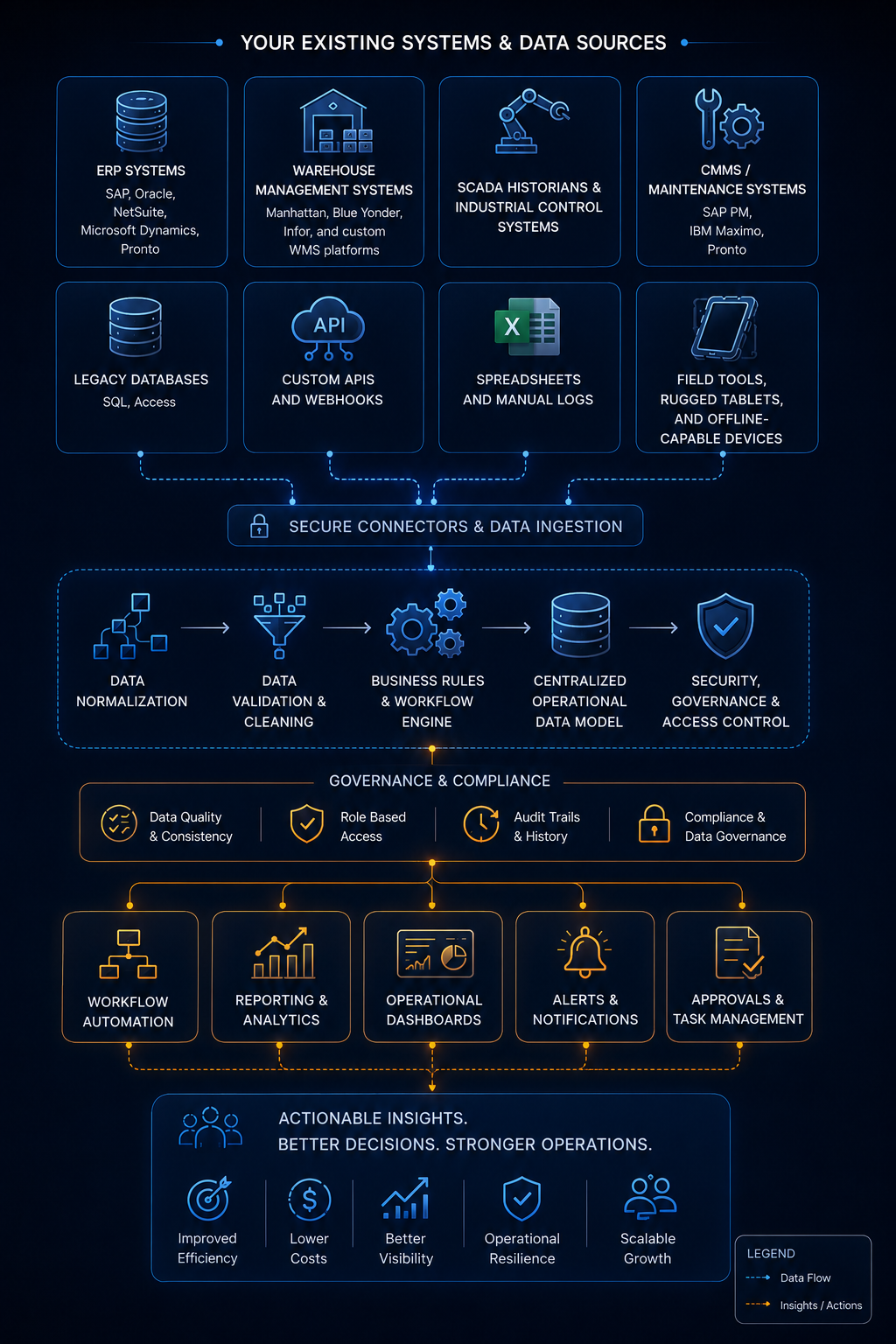
ERP, WMS, SCADA, CMMS, databases, spreadsheets, APIs, and manual logs.
Integration opportunity list for connecting existing systems without unnecessary replacement.
Site-to-site reporting, regional consolidation, shared dashboards, and cross-site approvals.
Coordination improvement plan for consistent visibility across locations.
KPIs, filters, user roles, operational views, alert needs, executive summaries, and whether AI-assisted pattern detection is genuinely warranted by your data.
Practical dashboard and alerting requirements aligned to decisions - not vanity metrics or AI added for its own sake.
The process follows the same operations-first approach used throughout our build work, outlined in full on our implementation approach page. We start by understanding how the business actually runs, then connect that reality to reporting, workflow, dashboard, and integration requirements.
We begin with the operating model: teams, sites, systems, shifts, responsibilities, current reports, and the decisions leaders need to make faster.
We document how work actually moves through the operation, including handoffs, approvals, spreadsheets, messages, system updates, and manual checks.
We isolate delays, duplicated effort, unclear ownership, data re-entry, approval queues, reporting lag, and recurring coordination issues.
We compare what teams need to see against what they can see today across systems, sites, dashboards, reports, and informal communication channels.
We provide a practical path covering reporting automation, workflow automation, dashboard requirements, AI component scope where relevant, integrations, and a phased build-and-deployment plan.
The assessment is designed to create usable operational clarity, not a generic slide deck. You receive a structured view of where visibility breaks down, what can be improved first, and specifically what Novark Labs would build.
A concise summary of the current reporting, workflow, visibility, and coordination issues affecting day-to-day operations.
A practical list of the delays and friction points that slow down approvals, reporting, warehouse activity, production updates, or field execution.
A mapped view of the areas where managers, supervisors, and executives do not have timely or reliable operational information.
Specific recommendations for improving handoffs, approvals, reporting loops, dashboard inputs, and operational accountability.
A prioritised set of systems Novark Labs would build - reporting automation, workflow automation, dashboards, and AI-assisted components only where the data justifies them - based on operational impact, with a phased deployment plan.
The assessment does not assume your current software needs to be replaced. In most operations, the fastest improvement comes from connecting existing systems, reducing manual reporting, and building a practical visibility layer around the tools already in use.
Share a few details about your operation and the visibility challenges you want reviewed. The form is structured to help Novark Labs understand your environment before the first discussion.
A focused assessment usually takes 1 to 3 weeks depending on the number of sites, workflows, systems, and stakeholder groups involved. It runs through structured remote sessions with your operations and IT teams - the same remote-first approach Novark Labs uses for every engagement, regardless of your location.
No. The assessment is designed to understand what you already use and identify where visibility, reporting, integration, or workflow improvements can be built around your existing ERP, WMS, SCADA, or CMMS - not replace them.
No. The assessment is a standalone deliverable - a clear picture of your operational bottlenecks and a specific recommendation for what Novark Labs would build to address them. Many businesses use the findings to plan internally before committing to anything further. If you do want to move forward, the assessment becomes the foundation for the workflow mapping stage of our build process, so nothing from it is wasted either way.
Yes. We regularly assess environments where ERP, WMS, and SCADA systems are already part of the operational stack. The goal is to understand how that data currently connects - or fails to connect - to daily workflows, reporting, dashboards, and decisions, and what integration work would close the gap.
Yes. Multi-site visibility is one of the most common reasons to run the assessment, especially when each location reports differently, calculates KPIs differently, or relies on separate manual tracking methods.
It's assessed, not assumed. Part of what we review is whether your operational data and patterns genuinely warrant AI-assisted components like anomaly detection or pattern monitoring, or whether a simpler rule-based system would serve you better. Novark Labs doesn't recommend AI by default - the assessment includes an honest view of where it would and wouldn't add real value for your specific operation.
We focus on logistics, warehouse, manufacturing, industrial, and field operations where reporting delays, workflow bottlenecks, and fragmented operational data create measurable friction - including operations across Perth, Adelaide, Dammam, and Al Khobar.
No. The assessment is conducted through structured remote sessions - video calls with your operations and IT teams, screen-shared system walkthroughs, and document review. This is how Novark Labs delivers assessments and full builds across every market we work in.
No - the deliverable has substance regardless of what you decide afterward. You receive a documented view of your reporting delays, workflow bottlenecks, and visibility gaps, plus a specific build recommendation, whether or not you proceed. If the honest answer is that your current systems don't need much intervention, we'll tell you that too.